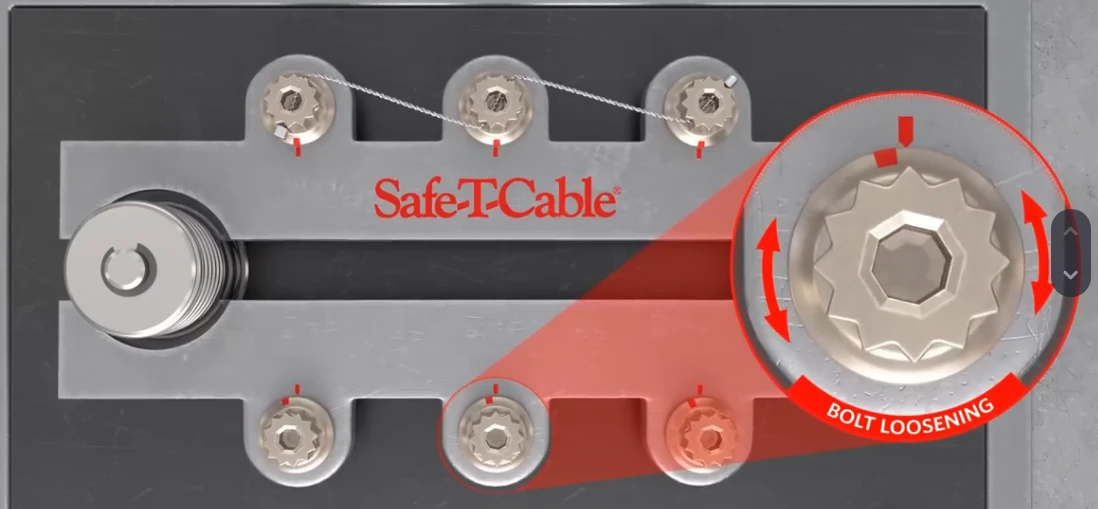
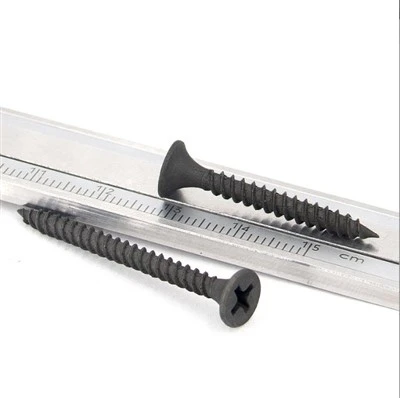
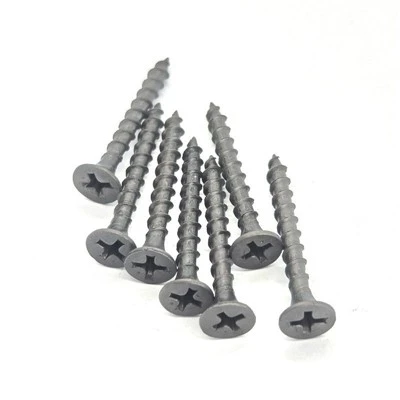
Many people hold a misunderstanding: if a bolt is tightened hard enough, it will never loosen. However, under high-frequency vibration and continuous impact in industrial equipment, ordinary fastening methods cannot withstand long-term working conditions. Even high-strength bolts used on train chassis and heavy-duty machinery will suffer thread loosening and back-off under long-term bumping, vibration and alternating loads, directly threatening equipment operation safety.
Some people may ask: can extreme tightening completely lock the bolt?
This is a typical wrong operation. Excessively exceeding the bolt's preload limit will not prevent loosening; instead, it will directly cause tensile deformation or brittle fracture of the bolt, triggering severe equipment failure.
Insufficient tightening leads to loosening, while over-tightening causes fracture. The core standard for industrial working conditions is: no over-limit stress, no loosening, and stable locking. This article professionally disassembles 7 mainstream bolt anti-loosening structures for on-site engineering application.
1.Washer: Cost-effective but Vibration-sensitive

The spring washer is the most basic anti-loosening fastener. In conventional cognition, flattening the washer during tightening can provide continuous axial elastic rebound force to eliminate thread clearance and prevent nut loosening.
However, verified by professional Junker vibration tests, this structure is only suitable for static and low-vibration working conditions. Under severe lateral shear and reciprocating sliding loads, the tension of the spring washer instantly drops to zero, the thread clearance reappears, and the anti-loosening function completely fails, making it incompetent for heavy industry and rail transit scenarios.
2.Double Wedge Lock Washer: Upgraded Anti-loosening Solution for Severe Vibration
To solve the vibration failure defect of ordinary spring washers, engineers developed double wedge lock washers, which are currently one of the mainstream reliable anti-loosening solutions for high-vibration industrial conditions.
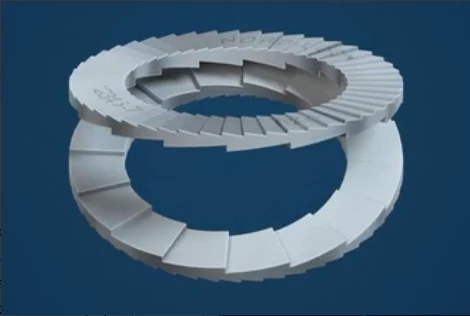
Structurally, the outer side of the washer is equipped with hardened anti-slip serrations, and the inner side is a precision inclined slope. When installed with two matched washers fitted face-to-face, the outer hardened serrations bite tightly into the metal contact surface, completely locking the upper and lower displacement of the washer assembly.
Its core anti-loosening mechanism is superior to traditional washers: vibration-induced loosening force cannot break the outer bite lock and only acts on the inner fitting slope. The key design is that the inner slope angle is larger than the thread lead angle.
Once the nut tends to rotate backward and loosen, it will climb upward along the inner slope, reversely lifting preload tension on the bolt. The stronger the equipment vibration, the greater the clamping force, achieving tighter locking under intense vibration.
3.Double Nut Counter-tightening: Zero-clearance Locking with Standard Parts

Without special anti-loosening washers, high-strength anti-loosening can be realized only through standard fasteners via the double nut counter-tightening process.
Install one thick nut and one thin nut in stack at the bolt end. The anti-loosening key lies in the final counter-locking operation: fix the lower thick nut and upward tighten the thin nut with two wrenches simultaneously to form bidirectional opposite pressure.
This reverse force completely eliminates thread fitting clearance, realizes full rigid meshing of thread teeth, removes thread idle travel, and fundamentally prevents thread back-off caused by vibration, featuring high reliability and zero special accessory requirements.
4.Integrated Self-locking Nut: Accessory-free Single Nut Locking
To simplify the cumbersome double-nut operation, integrated self-locking nuts are designed to achieve efficient anti-loosening performance with a single piece, mainly divided into two mainstream types with different working principles.
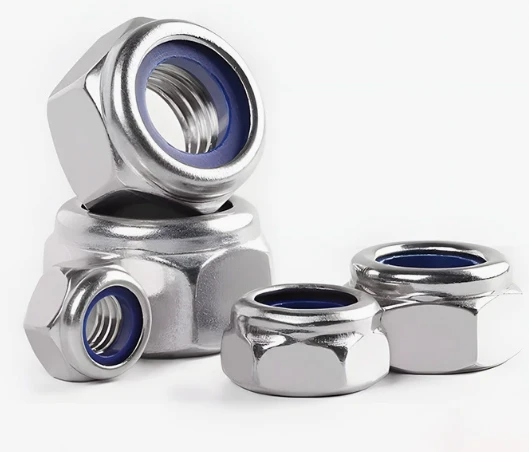
1.Nylon Insert Lock Nut
A thread-free nylon ring is reserved at the nut tail with an inner diameter slightly smaller than the bolt nominal diameter. When the bolt is screwed in, it extrudes the nylon ring to form matched thread patterns. Relying on the high elasticity and high damping of nylon, it provides continuous full-circle clamping force on the bolt and effectively suppresses vibration-induced thread rotation.
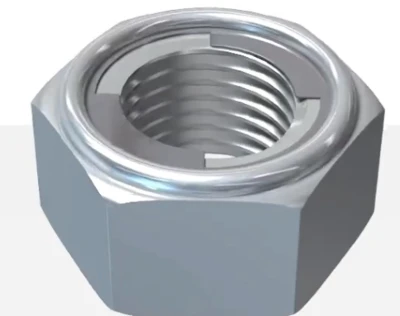
Adopting an all-metal structure, it adapts to extreme working conditions such as high temperature and heavy oil pollution where nylon materials fail. The top thread port is mechanically stamped into a slight ellipse during production.
When a standard round bolt is screwed in, it forcibly expands the elliptical port. The metal body generates continuous elastic rebound stress to clamp the bolt thread evenly from all directions, realizing rigid locking through pure metal interference fit without elastic attenuation and with superior durability.
5. Thread Locking Adhesive: Chemical Filling and Curing Locking
For precision equipment and small-thread assembly where washer and nut structures cause volume redundancy, anaerobic thread locking adhesive serves as the optimal universal chemical anti-loosening solution.
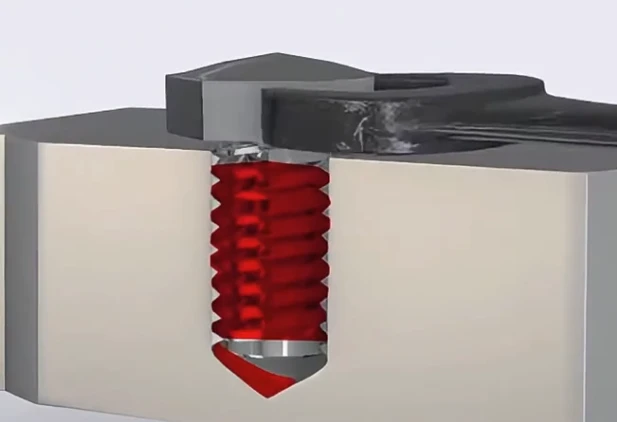
The core feature of anaerobic adhesive is: non-curing in air, rapid curing under air isolation. After being coated on the thread surface and screwed tight, the adhesive in the thread gap is isolated from air and quickly cures into a hard layer to fill all microscopic thread gaps.
Its anti-loosening principle includes filling and bonding: the cured adhesive fixes the relative position of thread teeth to eliminate shaking gaps, and bonds the bolt and nut metal surfaces to improve thread rotation damping and resist vibration loosening torque.
Different strength grades apply to different conditions: low-strength adhesive supports repeated disassembly and assembly; medium and high-strength adhesive realizes permanent locking, suitable for high-temperature, micro-vibration and precision sealing scenarios, with additional anti-rust and anti-corrosion functions.
6.Split Pin + Castle Nut: Forced Mechanical Rigid Locking

As a classic passive mechanical locking structure, it is widely used in high-safety-level scenarios such as construction machinery, vehicle suspension and hoisting equipment. It abandons friction locking and eliminates loosening completely through structural rigid limit.
Its main disadvantages are complicated installation, non-reusability and high alignment precision requirements, so it is only applied to key load-bearing and safety-limiting components rather than mass lightweight assembly.
7.Serrated Flange Self-locking Nut: Integrated High-efficiency Locking Structure
As an integrated industrial optimized solution, the serrated flange self-locking nut combines pressure bearing, anti-slip and self-locking functions into one part. It requires no additional washers or adhesive, simplifying assembly while ensuring high anti-loosening performance, widely used in auto parts and automated equipment.
The integrated flange plate at the nut bottom is processed with dense radial hardened serrations. During tightening, the serrations press into the surface metal of the workpiece to form physical bite limit, completely locking the nut's circumferential rotation degree of freedom.
Compared with ordinary nuts, it has three core advantages: the flange increases bearing area to avoid workpiece crushing; the integrated structure eliminates accessory falling risks and enhances anti-vibration and shear resistance; the simplified process adapts to automated mass production with balanced efficiency and reliability.